Language Home
German English
Invented
English Words
Finnish
English
Swahili
English
Short Story
Search
Sources
Language
Links
Books:
-Language Books
-Foreign Language Books
-Dictionaries
A
B C D E F G H I J K
L M N O P Q R S
T U V W X Y Z

A
B C D E F G H I J K
L M N O P Q R S
T U V W X Y Z
|
Please do not plagiarize. If you would
like to use this information in a print or electronic publication,
please ask me for
permission first and cite this page as:
Knapp, Robbin D.
2009. "Swahili
English: S". In Robb:
Swahili English. Jan. 6, 2009.
You can order most of the cited books and other media through Amazon simply by clicking on the titles.

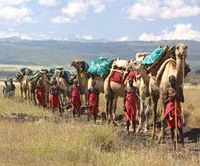
- safari n.
- from safari "journey, voyage, expedition;
caravan, company of persons travelling together, equipped party or
expedition": an expedition or journey, often on foot, as for
hunting, especially in eastern Africa; any long or adventurous
expedition; the caravan of such an expedition [< Swahili <
Arabic safari, safariy "pertaining to a journey",
safara "to travel"].
- "The young man casually mentioned that he always took
Bannerman's own work on West African birds with him on safari. 'Not
all eight volumes?!' exclaimed Bannerman; to which the gentleman
casually replied: 'It only means another porter!'" Stephen
Moss, A Bird in the Bush: A Social History
of Birdwatching, 2004, p. 136.
 "He had friends who were into
extreme vacations – backpackers and whitewater rafters, gorilla
trekkers, safari types always trying to outdo the rest with tales of
near-death experiences on the other side of the world." John
Grisham, The Testament, 1999, p. 117. "He had friends who were into
extreme vacations – backpackers and whitewater rafters, gorilla
trekkers, safari types always trying to outdo the rest with tales of
near-death experiences on the other side of the world." John
Grisham, The Testament, 1999, p. 117.- "So I called my travel agent and said I wanted to
climb Kilimanjaro, and the agent said no problem; she'd set it up to
follow the safari; we should remember to pack boots and a parka, and
that was that." Michael Crichton, Travels, 1988, p. 167.
- "Yet another safari tourist met with an early demise
when she left the safety of the tour bus, in the face of numerous
explicit warnings, in order to frame a better picture." Wendy
Northcutt, The Darwin Awards II, 2001, p. 30.
- "No boat had left the harbor in the meantime -- there
was not a railroad within hundreds of miles -- there was no other
white settlement that the two could reach under several days of
arduous marching accompanied by a well-equipped safari."
Edgar Rice Burroughs, The Son of Tarzan, 1915, p. 31. Safari
is used 22 times in this book.
- "The war was not a safari." Wayne Karlin, Le Minh
and Truong Vu, The Other Side of Heaven: Postwar
Fiction by Vietnamese and American Writers, 1995.
- "Green women's perfumes include Vent Vert, Chanel No.
19, Alfred Sung, and Safari." Edwin L. Morris, Scents of Time: Perfume from Ancient
Egypt to the 21st Century, 2000.
- More books and products related to safari
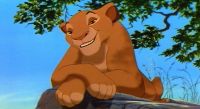  Sarabi n. Sarabi n.- from sarabi "mirage": the name of a
particular lion in Disney's Lion King [< Swahili < Arabic].
- "Mufasa, the Lion King (Samuel E. Wright); the
grown-up hero, Simba (Jason Raize); and Simba's
mother, Sarabi (Gina Breedlove) wear their masks above their heads,
somewhat like bishops' miters." Michael Tueth, "The Lion King (review)", America,
Jan. 17, 1998.
- shauri, shauria n.
- from shauri "discussion, debate":
trouble, a row or fracas [< Swahili < Arabic].
- "Some half-dozen of the Yowa people came near, and the
shauri began." Henry M. Stanley, Through the Dark Continent (Volume 2),
p. 388, as quoted in William James, Principles of Psychology (Volume 2),
1890.
- "As there happened to be gathered, at this time,
several thousand of warriors for the purpose of a council, or
shauri, with the District Commissioner we had just the audience to
delight our barbaric hearts." Stewart Edward White, The Land of Footprints, 1913.
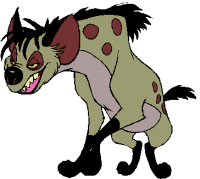 shenzi adj., n. shenzi adj., n.- from -shenzi "barbarous, uncivilized,
uncouth": a pejorative designation for native Africans or their
ways, language, etc.; the name of a particular hyena in Disney's Lion King [< Swahili < Persian].
- "However, after having been in our employ a little
while, and after having adopted the fez, jersey, and short
trousers—and, as a matter of pure pride and symbolism,
boots—they all regarded themselves as of an elevated social
status, and openly looked down on the unregenerated 'shenzis' or
natives who were still in the kirtle-of-banana-leaves cultural
stage." Theodore Roosevelt, A Book-Lover’s Holidays in the Open,
1916.
- "To bolt for the safety of a tree is to beg the
question completely, to brand himself as a shenzi forever; to fire a
gun in any circumstances is to beg the question also, for the white
man must be able to depend absolutely on his second gun in an
emergency." Stewart Edward White, The Land of Footprints.
- Simba n.
- from simba "lion": name given to lions in
stories [< Swahili].
 Lion King II: Simba's Pride, by Eric
Suben & Art Mawhinney, 1998. Lion King II: Simba's Pride, by Eric
Suben & Art Mawhinney, 1998.- "For a time he felt no doubt as to the outcome -- the
strange white man must certainly succumb to terrible Simba --
whoever heard of a lone man armed only with a knife slaying so
mighty a beast!" Edgar Rice Burroughs, Tarzan and the Jewels of Opar, p. 30.
- "We were now opposite a hill on the south called
Simba, a lion, from its supposed resemblance to that animal."
David Livingstone, The last journals of David
Livingstone, in Central Africa From eighteen hundred and sixty-five
to his death, 1875, p. 42.
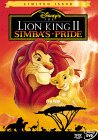 Lion King II: Simba's Pride, directed
by Rob LaDuca & Darrell Rooney, 1998. Lion King II: Simba's Pride, directed
by Rob LaDuca & Darrell Rooney, 1998.- More books and products related to Simba
- Swahili n.
- See Kiswahili.
|




